
UK data protection and GDPR
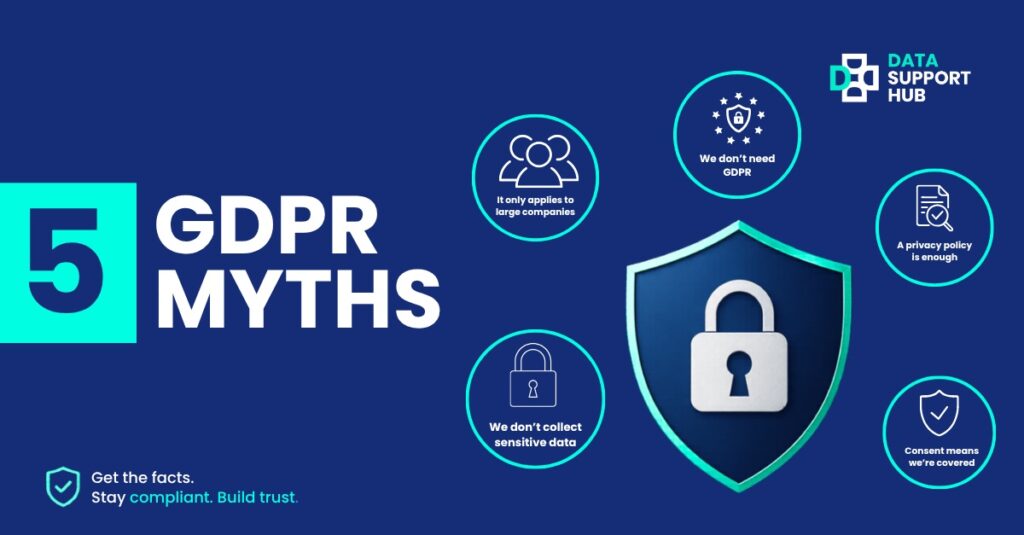
For UK SMEs, data protection can feel like one more compliance headache. The trouble is that a lot of small businesses still rely on half-truths. That can lead to poor decisions, unnecessary admin, or worse, avoidable mistakes. Here are five myths worth clearing up.
Myth 1: “A privacy policy is enough”
A privacy notice is important, but it is not the whole compliance story. The ICO says UK GDPR compliance also depends on how you build data protection into your processes, and you should limit use of personal information to what is necessary for each specific purpose. You should choose appropriate technical and organisational measures based on your company circumstances.
Common question: “Do we need a long, legal document?”
Not necessarily. Clear, understandable privacy information in a layered format that gives people the essentials first often works better than a wall of legal text nobody reads
Myth 2: “If there’s a breach, we just fix it quietly”
A personal data breach is not something to leave untracked. Notifiable breaches must be reported without undue delay and, where feasible, within 72 hours of becoming aware of them.
Common question: “What counts as a breach?”
In practice, it can be anything from sending personal data to the wrong recipient to losing a device or exposing data through a security lapse.
Myth 3: “Using cloud software means GDPR compliance is the provider’s responsibility”
Many businesses believe that once data is stored in a cloud platform, responsibility shifts to the software provider.
While cloud providers have their own security and compliance obligations, your business remains responsible for how personal data is collected, used, shared, and managed.
Common question: “If we use Microsoft 365, Xero or Salesforce, are we automatically compliant?”
No. Choosing a reputable provider is important, but compliance also depends on how your business configures systems, controls access, trains staff, manages retention periods, and responds to data subject requests. Technology can support compliance, but it cannot replace good governance.
Myth 4: “Employee data isn’t covered in the same way as customer data”
Some SMEs focus heavily on customer information but overlook employee records. Employee data is personal data and must be protected in the same way.
Common question: “Does GDPR apply to HR files and recruitment records?”
Yes. CVs, performance reviews, payroll information, sickness records, disciplinary notes, and contact details all contain personal information. Employers should ensure that employee data is collected for legitimate purposes, stored securely, accessed only by authorised staff, and retained for appropriate periods. Privacy notices for employees are also an important part of transparency obligations.
Myth 5: “We don’t need to think about GDPR until something goes wrong”
Some businesses treat data protection as a reactive exercise and something to address after a complaint, subject access request, or breach occurs. This puts the business at risk of non compliance as well as not being able to properly respond to SARs, breaches and complaints within the deadline.
Common question: “Do we need to document anything if we’ve never had a problem?”
Yes. The principle of accountability requires organisations to demonstrate compliance, not simply claim that they are compliant. For SMEs, this may include:
- Maintaining appropriate privacy notices.
- Understanding what personal data is held.
- Recording key data protection decisions.
- Reviewing suppliers and contracts.
- Training staff.
- Having procedures for handling requests and breaches.
- Knowing where data is stored, and how to access it, to respond to requests and breaches.
Good compliance is about preparation rather than firefighting.
A few simple habits that make life easier
For most SMEs, good compliance starts with a handful of basics: decide your lawful basis before you start processing, give people clear privacy information, keep security proportionate to the risk, train staff to recognise access requests and breaches, and check whether you need to pay the ICO data protection fee.
GDPR is not just for big enterprises, and it is not just about paperwork. For UK SMEs, the real goal is to be clear, be proportionate, and build data protection into everyday business habits.